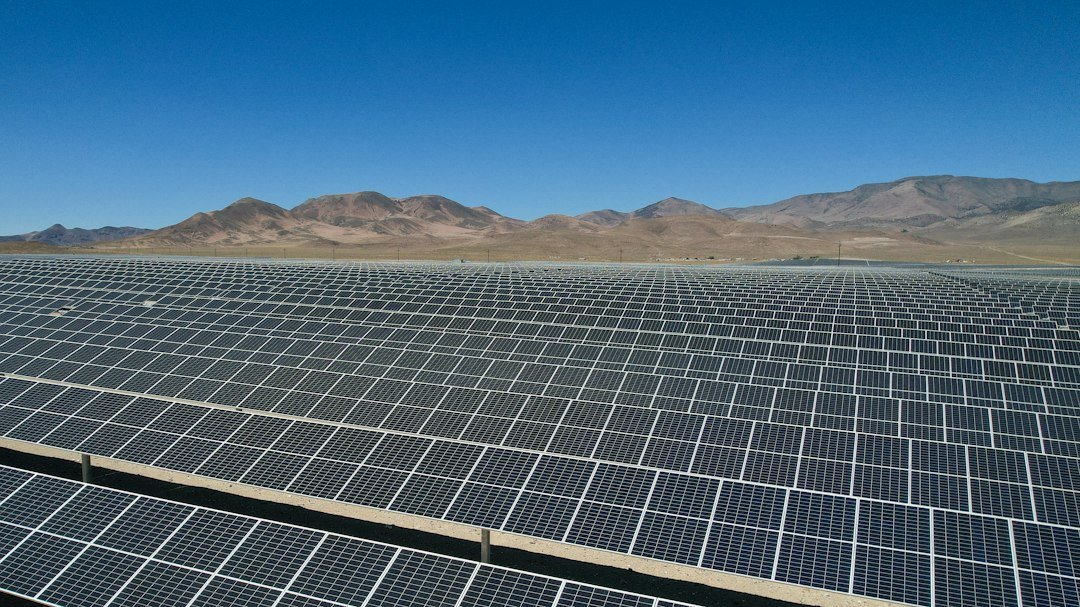
Solar power has one obvious weakness: the sun sets. A new project in Abu Dhabi aims to solve that problem at a scale never attempted before. Masdar, the UAE’s state-backed renewable energy company, has reached financial close on a US$6.1 billion solar-plus-storage plant designed to deliver clean electricity 24 hours a day.
Masdar describes it as the world’s first gigascale round-the-clock renewable energy project. With financing now secured, it has moved from an ambitious plan to a funded construction project.
Key takeaways
- The project combines 5.2GW of solar panels with a 19GWh battery storage system.
- It is designed to supply 1GW of steady baseload power, day and night.
- Total investment is $6.1bn, with Masdar providing $1bn of equity and a group of 13 banks lending $5.1bn.
- Construction started in October 2025, and operations are expected in 2027.
How round-the-clock solar works
It may seem odd that a plant needs 5.2GW of solar panels to provide just 1GW of power. The reason is simple: solar panels only generate during daylight hours, and output peaks around midday. To supply a constant 1GW through the night, the plant must produce far more than it needs during the day and store the surplus.
That is where the 19GWh battery system comes in. During the day, the solar farm meets demand directly and charges the batteries at the same time. After sunset, the batteries discharge to keep the 1GW supply flowing until the sun rises again. In effect, the project turns an intermittent energy source into something that behaves like a conventional power station.
Who is involved
- Developer: Masdar, in partnership with Emirates Water and Electricity Company (EWEC)
- Buyer: EWEC, under a long-term power purchase agreement, with private users such as data centres able to buy power through back-to-back arrangements
- Construction: India’s Larsen & Toubro and China’s PowerChina
- Solar panels: JinkoSolar and JA Solar, each supplying 2.6GW of modules
- Lenders: a consortium of 13 international and local banks
Built for data centres and AI
A key target market is large energy users that need power every hour of the day, particularly data centres and technology companies running artificial intelligence workloads. These facilities cannot shut down at night, and many of their customers want clean electricity to meet climate commitments. A reliable 24/7 renewable supply gives Abu Dhabi a strong selling point as it competes to host the region’s growing digital infrastructure.
The bigger Gulf solar picture
The project arrives during a boom in Gulf solar. The region added a record 12.2GW of solar capacity in 2025, taking its total to about 34.5GW, and BloombergNEF expects the wider Middle East and North Africa to add a record 18GW in 2026. National targets are ambitious: Saudi Arabia aims for renewables to supply about half of its electricity by 2030, while the UAE plans to triple its clean energy capacity by the same year on the way to net zero by 2050.
But building fast is not always easy. Gulf utilities regularly announce record-low solar prices, yet getting plants connected to the grid on schedule depends on supply chains, financing and construction capacity. Projects like Masdar’s show that the industry is moving on from the question of cheap daytime power to the harder challenge of reliable power at all hours.
Why it matters
- Solving intermittency: it demonstrates that solar plus batteries can provide steady baseload power at gigawatt scale.
- Bankability: securing $5.1bn of loans shows lenders now see round-the-clock renewables as a commercial investment, not an experiment.
- Energy transition: it helps the UAE cut reliance on gas-fired power while meeting rising demand.
- A model for others: if it performs as planned, similar projects could follow across the Gulf and in other sunny regions.
Frequently asked questions
When will the project start operating?
Masdar expects operations to begin in 2027.
What does “financial close” mean?
Financial close is the point at which all funding agreements are signed and money can be drawn down. It means the project is fully funded and construction can continue without financing uncertainty.
How big is Masdar?
Masdar says its global renewable portfolio exceeds 65GW across solar, wind, battery storage and hybrid projects.
Photo: Manny Becerra on Unsplash (illustrative).