Getting into central Makkah has always been one of the hardest transport problems in the Gulf. Millions of pilgrims, residents and workers converge on a small, densely built area around the Grand Mosque, often within the same few hours, and much of that movement still depends on private cars, taxis and seasonal coach fleets. Saudi Arabia has now taken a large step towards changing that pattern, signing a set of private-sector deals for a dedicated access network called Wasel Al-Haram.
The agreements, worth SAR5.664 billion (about $1.51 billion), were signed in Jeddah on 8 November 2026 at the opening of the sixth Hajj Conference and Exhibition. They cover new stations, parking facilities and transport corridors feeding the city centre, and they are being paid for entirely by private investors rather than the state. This article explains what was agreed, how it builds on Makkah’s existing transport system, and what to watch as the project moves into delivery.
Key takeaways
- Makkah’s General Transport Center signed three public-private partnership (PPP) packages worth SAR5.664bn ($1.51bn) for the Wasel Al-Haram project.
- The network will include 19 stations and parking facilities across seven corridors, covering 3.1 million square metres, plus a fleet of 3,200 buses.
- It is designed to serve around 205 million passengers a year across the three packages.
- A consortium of Saudi Alqaid, Spain’s Moventis and Indonesia’s Waskita won packages one and three; the Mawgif consortium won package two.
- Officials estimate a GDP contribution of SAR11–12bn and 2,800–3,000 jobs over an investment period of seven to ten years.
What was signed
The client is the General Transport Center, which acts as the executive arm of the Royal Commission for Makkah City and Holy Sites and is responsible for planning, regulating and operating the city’s transport network. It split Wasel Al-Haram into three investment packages, each structured as a PPP in which the private partner provides the full financing.
Two groups share the work. A consortium led by Saudi Alqaid Co, alongside Spanish bus and mobility operator Moventis and Indonesian state-owned contractor Waskita, took the first and third packages. The second package went to a consortium led by Mawgif, a Saudi company known for parking management. The mix is telling: it pairs a local developer with an experienced international transit operator and a large construction firm, which is broadly the skill set a park-and-ride system needs.
| Item | Detail |
| Total value | SAR5.664bn (about $1.51bn) |
| Structure | Three PPP packages, fully privately financed |
| Stations and parking sites | 19, across seven corridors |
| Total land area | 3.1 million sq m |
| Bus fleet | 3,200 buses |
| Planned capacity | About 205 million passengers a year |
| Estimated GDP impact | SAR11bn–12bn |
| Jobs | 2,800–3,000 |
How the system is meant to work
The idea behind Wasel Al-Haram, whose name roughly means a connector to the Haram, is simple: stop as many vehicles as possible before they reach the congested core. Visitors would leave cars or coaches at large parking facilities on the approaches to the city, then complete the journey on high-frequency buses running along dedicated corridors to stations near the central area.
The scale is what stands out. A fleet of 3,200 buses is roughly eight times the size of the regular Makkah Bus service, and a target of around 205 million passengers a year implies the network will be busy all year round, not just during Hajj. That matters because Umrah, the pilgrimage that can be performed at any time, now brings large crowds to Makkah throughout the calendar, with sharp peaks during Ramadan and school holidays.
Background: building on the Makkah Bus network
Wasel Al-Haram does not start from zero. The Royal Commission launched trial operations of the Makkah Bus project in February 2022 on a route linking the Haramain high-speed rail station in Al Rusaifah with the Jabal Omar area near the Grand Mosque. The service, part of the Pilgrim Experience Program under Vision 2030, grew into a 12-route network operated with about 400 buses.
According to recent figures reported by Arab News, that network now runs over roughly 580km with 431 stations and has carried more than 188 million passengers. The city is also linked to Madinah and Jeddah by the Haramain High-Speed Railway, while the Al Mashaaer metro shuttles pilgrims between the holy sites during Hajj. Wasel Al-Haram is designed to fill the gap between these systems and the dense central district, focusing on high-volume access rather than city-wide coverage.
Why the PPP model matters
The financing structure may be as significant as the infrastructure. By asking private consortia to fund the stations, car parks and buses, and to recover their investment through operations over a long period, the Kingdom shifts capital costs off its own balance sheet. That fits a wider Saudi push to use PPPs for utilities, airports, schools and transport, and it comes at a time when Gulf governments are under pressure to manage spending carefully.
It also brings in foreign operating expertise. Moventis runs urban and intercity bus services in Spain, and Waskita is one of Indonesia’s largest construction groups. Indonesia is also the country that sends the most pilgrims to Saudi Arabia, so its participation has symbolic as well as commercial weight. For the local partners, the deals offer long-term, demand-backed revenue in one of the most reliable visitor markets in the world.
Challenges and what comes next
Delivering a network on this scale in Makkah is not straightforward. Land in and around the city is scarce and expensive, terrain is mountainous, and construction must continue around year-round crowds. Demand is also highly seasonal, which makes revenue forecasting harder for private investors: the system must be sized for Hajj and Ramadan peaks yet remain viable in quieter months.
Key details have not yet been made public, including the exact corridor routes, the opening timeline for each package, fare levels and how the new services will integrate with Makkah Bus ticketing. Those points will determine how quickly visitors actually change their habits. The next milestones to watch are design approvals, the start of works at the first parking sites and announcements on bus procurement, which at 3,200 vehicles would be one of the region’s larger fleet orders.
Frequently asked questions
Who is paying for Wasel Al-Haram?
The project is structured as public-private partnerships, and the official announcement states that all three packages are financed fully by the private sector partners rather than by the government.
Is this a metro or rail project?
No. Wasel Al-Haram is a bus-based system built around parking facilities, stations and dedicated corridors. It is designed to complement existing rail links such as the Haramain High-Speed Railway rather than replace them.
How does it relate to the Makkah Bus service?
Both fall under the General Transport Center. Makkah Bus provides city-wide routes for residents and visitors, while Wasel Al-Haram focuses on moving very large numbers of people between outer parking hubs and the central area around the Grand Mosque.
The bottom line
Wasel Al-Haram is a large, privately funded bet that park-and-ride buses can tame traffic around the Grand Mosque. With 19 hubs, 3,200 buses and capacity for about 205 million trips a year, it would significantly expand Makkah’s public transport, and it shows how Saudi Arabia increasingly expects private capital to build the infrastructure behind its visitor ambitions. The test now is delivery, integration and whether visitors choose to leave their cars behind.
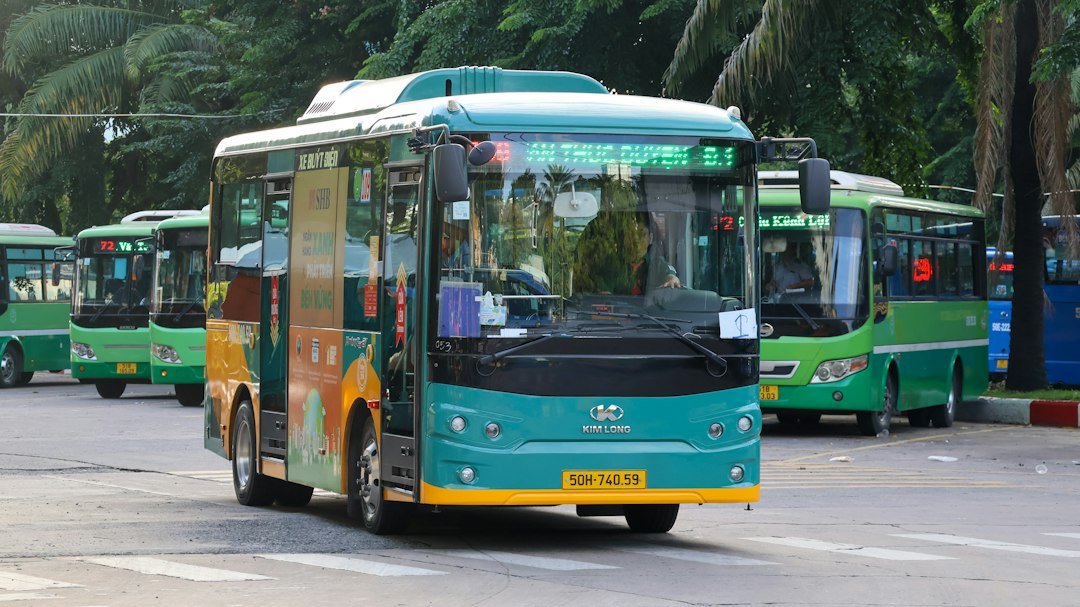
Photo: The Transport Enthusiast DC on Unsplash (illustrative).